 blog
blog
Comprehensive Small Business Insurance Plans: A Guide
Table of Contents
- What Comprehensive Small Business Insurance Plans Cover
- Understanding Business Owner's Policy (BOP) Benefits
- Small Business Insurance Cost Factors That Affect Your Premium
- How to Get Small Business Insurance Quotes
- Customizing Coverage for Your Business Size and Industry
- Why Claims Process Transparency Matters
- Frequently Asked Questions
Last Updated: September 18, 2026
What Comprehensive Small Business Insurance Plans Cover
Comprehensive small business insurance plans bundle essential coverages into one coordinated package to address the most common threats to small operations, rather than buying individual policies separately.
A solid comprehensive plan typically includes general liability coverage (protecting you if a customer is injured on your property or harmed by your products), property insurance (safeguarding buildings, equipment, and inventory against fire and theft), and often professional liability, workers compensation, and commercial auto coverage depending on your business type.
The real value of comprehensive small business insurance plans lies in coordination, when coverages work together, gaps disappear and claims are simplified.
Beyond core coverages, comprehensive plans often include business interruption insurance (replacing lost income during temporary closure) and cyber liability coverage (increasingly important as businesses handle customer data online).
Understanding Business Owner's Policy (BOP) Benefits
A Business Owner's Policy (BOP) bundles general liability, commercial property, and business interruption coverage into a single, simplified package. For many small business owners, a BOP forms the foundation of comprehensive small business insurance plans because it addresses the three biggest financial threats to operations.
The primary advantage of a BOP is simplicity: one integrated product instead of three separate policies with different renewal dates and deductibles.
A BOP automatically coordinates coverage to minimize overlaps and gaps: general liability covers customer injuries, property coverage handles fire damage, and business interruption replaces lost income during shutdown.
A BOP does not cover professional errors, vehicles, or employee injuries, which is why comprehensive small business insurance plans often layer a BOP with additional specialized coverages tailored to your operation.
Small Business Insurance Cost Factors That Affect Your Premium
Several factors determine premiums for comprehensive small business insurance plans, helping you anticipate costs and identify risk-reduction opportunities.
Industry and risk profile is the biggest driver. Construction companies face different hazards than consulting firms, resulting in dramatically different premiums based on claims history and lawsuit frequency.
Business size matters significantly. More employees increase workers compensation costs, larger facilities increase property insurance costs, and higher revenue typically requires higher liability limits.
Location affects your small business insurance cost factors, higher crime rates, frequent natural disasters, and higher legal award averages increase premiums.
Claims history is critical, multiple past claims increase premiums, while a clean history qualifies you for better rates.
Coverage limits and deductibles are levers you control, higher deductibles lower premiums by shifting more risk to you.
Safety measures matter too, documented safety protocols, employee training, and loss prevention measures often qualify for 5-10% discounts.
How to Get Small Business Insurance Quotes
Before requesting quotes, decide whether a bundled approach (Business Owner's Policy) or standalone policies make sense for your situation to ensure you're comparing apples to apples.
Bundle vs. Standalone: When to Choose Each
Choose a bundled BOP if: You're low-to-moderate risk, want simplicity, have straightforward needs, are price-sensitive, and have fewer than 50 employees.
Choose standalone policies if: You're high-risk, need higher limits, require industry-specific coverage, or have complex operations.
Most small businesses start with a BOP and add standalone policies for specialized needs.
Preparing Your Business Profile
Before requesting quotes, document: legal structure, years in business, number of employees, annual revenue, payroll amount, industry classification code (NAICS), square footage, claims history (past 5 years), and safety measures.
Identifying Your Coverage Needs
Don't guess at coverage. Use your risk assessment to determine what's essential:
-
Workers compensation, Mandatory if you have employees. Premium = payroll × industry rate per $100.
-
General liability, Essential if customers visit or you provide services. Typical limits: $1M/$2M.
-
Commercial property, Required if you own the building or have significant equipment/inventory. Premium depends on replacement value and location.
-
Professional liability, Essential for consultants, designers, accountants, therapists.
-
Commercial auto, Required if you operate vehicles for business.
-
Business interruption, Replaces lost income during forced closure.
-
Cyber liability, Covers breach response and liability if you handle customer data.
Requesting Quotes: What to Ask and How to Compare
When contacting insurers, ask: What's included in your standard BOP and what's excluded? What are your coverage limits and can they be increased? What's your average claims processing time and how do I file? What discounts do you offer? Do you have experience with my industry? What's your AM Best financial strength rating (A+ or higher preferred)?
Gather quotes from at least three insurers, different rating models produce significantly different prices for identical coverage.
Evaluating Quotes Beyond Price
When comparing quotes, create a comparison table:
| Factor | Insurer A | Insurer B | Insurer C |
|---|---|---|---|
| General Liability Limit | $1M/$2M | $1M/$2M | $1M/$2M |
| Property Coverage | $500K | $500K | $500K |
| Deductible | $1,000 | $500 | $1,000 |
| Annual Premium | $2,100 | $2,850 | $2,400 |
| Bundling Discount | 20% | 15% | 18% |
| Claims Processing | Online 24/7 | Phone/email | Online + phone |
| AM Best Rating | A+ | A | A+ |
| Industry Experience | Retail | General | Retail |
The cheapest quote isn't always the best value, consider claims support, industry expertise, and deductible costs when comparing.
Red Flags to Avoid
- Quotes significantly lower than others (often indicates missing coverage or low financial stability)
- Insurers who won't explain what's covered or excluded
- No online claims filing or 24/7 claims reporting
- AM Best rating below A-
- Pressure to buy before you've reviewed the full policy
- Vague answers about claims processing time or deductible amounts
Once you've selected an insurer, request the full policy documents before signing. Review the coverage limits, exclusions, and deductibles one final time. Insurance is only valuable when you understand what it covers.
Customizing Coverage for Your Business Size and Industry
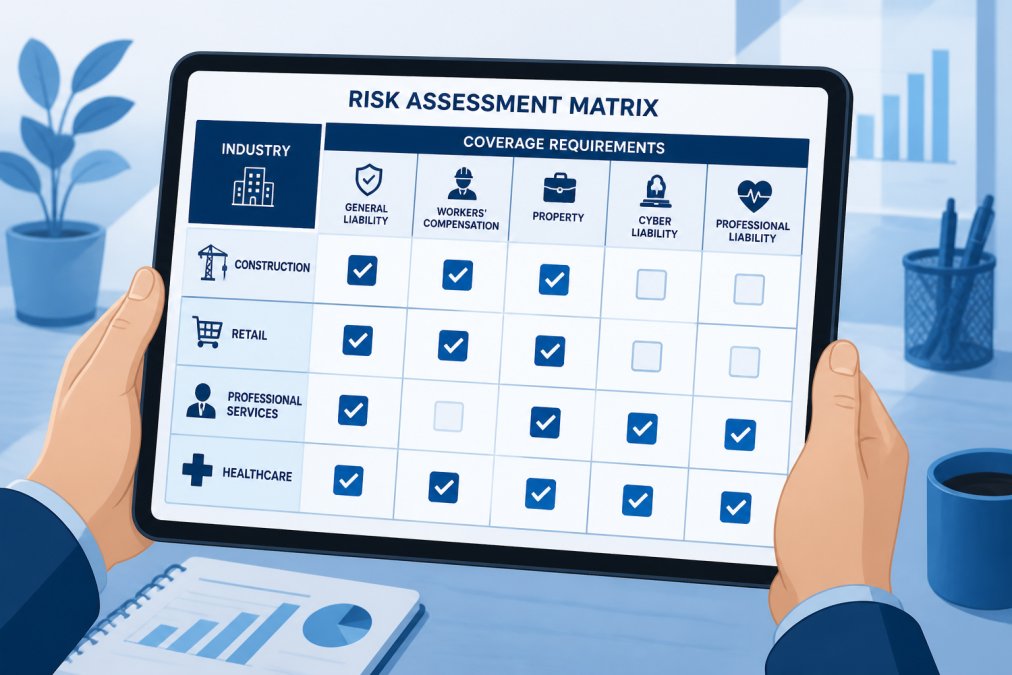
One-size-fits-all insurance doesn't work for small business insurance plans because businesses operate in vastly different environments. Customizing coverage to match your specific situation requires a structured risk assessment.
Industry Risk Segmentation: High-Risk vs. Low-Risk Profiles
Insurers classify industries into risk tiers that directly affect both premium and available coverage options. Understanding where your business falls helps you anticipate what coverages are non-negotiable versus optional.
High-risk industries (construction, healthcare, childcare) face frequent injury claims and regulatory exposure.
Low-risk industries (consulting, accounting, software development, graphic design, virtual assistance, bookkeeping) have fewer physical hazards and lower injury exposure. These businesses typically need:
- General liability with $1 million per occurrence (often sufficient)
- Professional liability to cover errors, omissions, or advice-related claims
- Cyber liability if handling client data or payment information
- Workers compensation only if you have employees
Risk Assessment Checklist for Customization
-
Do you have employees? If yes, workers compensation is mandatory in all states except Texas, South Dakota, Wyoming, and Oklahoma (and even in those states, most insurers require it). Premium is based on payroll and industry classification code.
-
Do customers or the public enter your location? If yes, general liability is essential. Slip-and-fall claims are the #1 source of small business liability losses.
-
Do you own or operate vehicles for business? Personal auto policies exclude business use. If you make client visits, deliveries, or site inspections, commercial auto coverage is required. A single claim denial due to business-use exclusion can cost $50,000-$500,000+.
-
Do you provide advice, design, treatment, or professional services? Professional liability covers claims that your work caused financial loss or harm. A missed deadline, design flaw, or treatment error can trigger litigation costs of $10,000-$100,000+ even if the claim is ultimately dismissed.
-
Do you own equipment, inventory, or tools worth more than $10,000? Commercial property coverage protects these assets. Your landlord's insurance covers the building structure only, not your business contents.
-
Could your business be forced to close temporarily due to fire, weather, or other covered event? Business interruption coverage replaces lost income during shutdown. For businesses with thin margins, this is often the most valuable coverage.
-
Do you handle customer payment data, health information, or personal data? Cyber liability covers breach response costs, notification expenses, and liability claims.
Coverage Customization by Business Model
Why Claims Process Transparency Matters
When you file an insurance claim, you want to know what happens next. Transparency in the claims process reduces stress and helps you plan your business recovery.
Frequently Asked Questions
What should be included in a comprehensive small business insurance plan?
A comprehensive small business insurance plan typically includes general liability coverage to protect against bodily injury and property damage claims, commercial property insurance for your building and equipment, professional liability if you provide services, workers' compensation if you have employees, and business interruption coverage. Many businesses also add cyber liability, umbrella coverage for extra protection, and specialized coverage based on their industry. The specific combination depends on your business type, size, and risk profile.
How do small business insurance cost factors affect my premium?
Your premium depends on several factors: your industry and associated risks, business revenue and payroll, location, claims history, coverage limits you choose, and your deductible amount. A manufacturing business typically pays more than a consulting firm due to higher risk exposure. Newer businesses may pay more until they establish a clean claims history. Improving workplace safety, implementing loss prevention measures, and bundling policies can help reduce your overall costs.
What are the main benefits of a business owner's policy (BOP)?
A business owner's policy (BOP) bundles general liability and commercial property coverage into one package, usually at a lower cost than buying policies separately. This simplifies administration since you have one policy, one renewal date, and one point of contact. BOPs offer flexibility to customize coverage based on your needs and typically provide faster claims processing. They're especially valuable for small to mid-sized businesses that need core protection without the complexity of multiple standalone policies.
How do I know if I'm getting the right coverage limits?
Determine your coverage limits by assessing your potential liability exposure. Review your assets, annual revenue, and the nature of your operations. For general liability, most businesses choose between $1 million to $2 million in coverage. Consider worst-case scenarios in your industry and consult with an insurance professional who understands your specific business risks. Your coverage should protect your personal assets and business operations from financial ruin if a claim occurs.